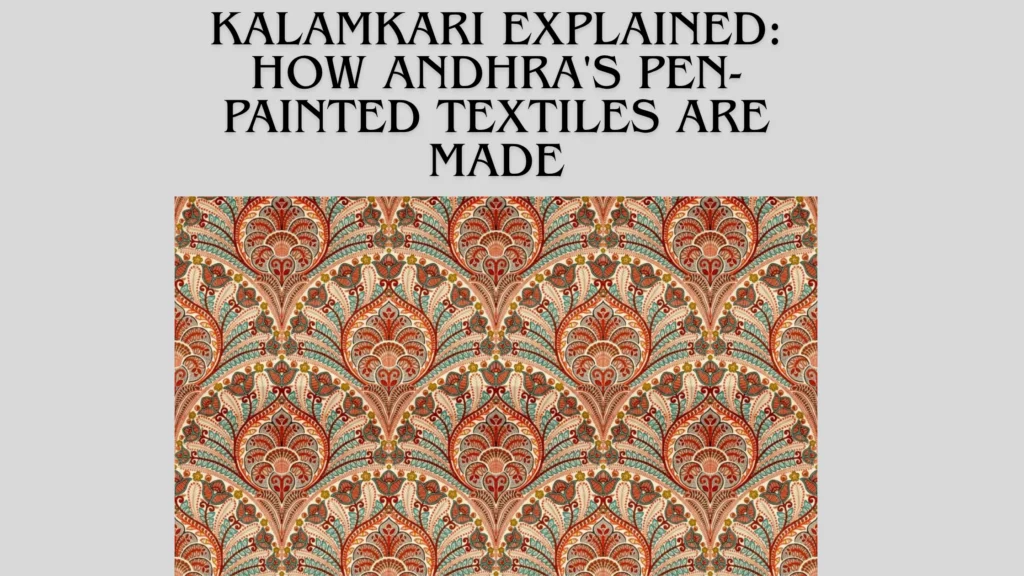
Walk through any Indian handloom exhibition and you will see “Kalamkari” printed on kurtas, dupattas and cushion covers. Much of it is screen-printed fabric that borrows the look. Genuine Kalamkari is something else: a slow, many-stage process of painting and dyeing cloth by hand with natural colours, practised for centuries in what is now Andhra Pradesh. Understanding how it is made changes how you see it.
What the name means
The word comes from kalam (pen) and kari (work or craftsmanship). The pen in question is a sharpened bamboo or date-palm stick, wrapped with a pad of cloth or wool that holds the dye and releases it slowly as the artist draws.
Two traditions, two very different styles
Srikalahasti: the pen-drawn style
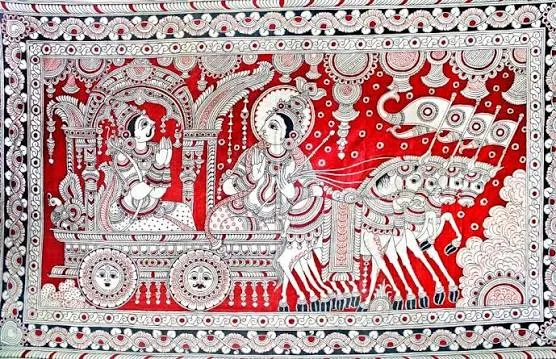
In Srikalahasti, a temple town near Tirupati, Kalamkari grew up around temple culture. Artists draw entirely freehand with the kalam, and the themes come from the epics and Puranas: scenes from the Ramayana and Mahabharata, the avatars of Vishnu, Shiva and Parvati, and stories of local deities. Large cloths were used as temple hangings, chariot banners and, in effect, illustrated storybooks for audiences who could not read. Panels are often arranged in rows like a comic strip, with captions in Telugu.
Machilipatnam and Pedana: the block-printed style
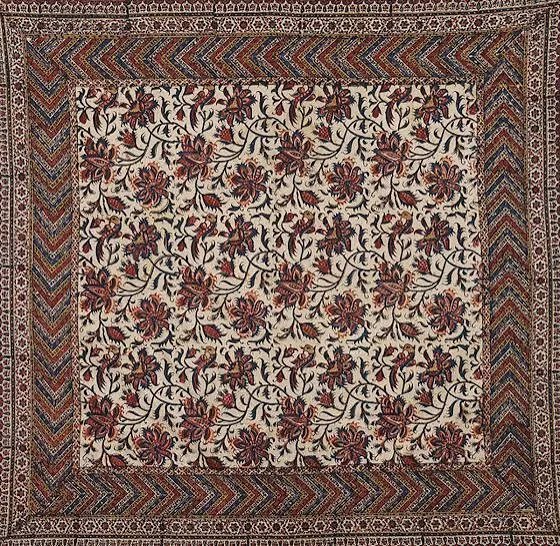
Along the coast, around Machilipatnam and the nearby weaving town of Pedana, a different style developed. Here outlines and large areas of colour are printed using hand-carved wooden blocks, with fine details added by hand. This style was shaped by trade: designs show strong Persian influence in their flowering trees, creepers, paisleys and medallions, and these textiles were historically exported widely and prized in overseas markets.
Both styles have Geographical Indication (GI) recognition, which protects their names for products made in their regions using the traditional methods.
How Kalamkari is made
The process varies between workshops and families, but genuine Kalamkari typically goes through a long sequence of steps that can take weeks for a large piece:
- Preparing the cloth: Cotton cloth is washed to remove starch, then soaked in a solution made from myrobalan (a dried fruit rich in tannin, known locally as karakkaya) and milk, often buffalo milk. This treatment prepares the fabric to hold the dyes and prevents colours from spreading. The cloth is then dried in the sun.
- Drawing the outlines: The artist sketches the design, traditionally with tamarind twig charcoal, then goes over it in black. The black dye is made by fermenting iron scraps with jaggery and water for days; it reacts with the tannin in the cloth to give a deep, permanent black.
- Mordanting for red: Areas meant to be red are painted with alum, a mordant. When the cloth is later boiled with natural dyestuffs from roots such as chay or madder, only the alum-treated areas take a strong red colour.
- Washing in running water: Between stages, the cloth is washed, often in flowing water, to remove excess dye and mordant. This is one reason Kalamkari centres grew up near rivers and canals.
- Adding blue and yellow: Blue comes from indigo, applied by dyeing or by painting. Yellow is typically painted on using plant sources such as myrobalan flowers or pomegranate rind. Green is created by layering yellow over blue.
- Finishing: The cloth is washed and dried repeatedly between stages, and the colours deepen and settle over time.
The result is a palette of earthy reds, rust, indigo, mustard, olive and black, with a softness that synthetic colours rarely match.
How to tell genuine Kalamkari from imitation
- Look at the reverse: Hand-dyed Kalamkari usually shows colour clearly on the back of the fabric. Screen prints often look much paler on the reverse.
- Check the colours: Natural dyes give slightly uneven, muted tones. Very bright, perfectly flat colours suggest synthetic dyes.
- Look for small irregularities: Slight variations in line width, minor smudges and differences between repeated motifs are signs of handwork. Perfectly identical repeats suggest machine printing.
- Smell and feel: New naturally dyed cloth can carry a faint earthy smell from the myrobalan and other plant materials, and the fabric often feels slightly crisp at first.
- Ask about origin: Buy from artisan cooperatives, government handloom emporiums or sellers who can name the workshop or region.
Caring for Kalamkari
Natural dyes are beautiful but gentle. Wash Kalamkari separately in cold water with a mild detergent for the first few washes, as some colour may bleed. Dry it in the shade rather than strong sunlight, and iron on the reverse. Expect the colours to mellow gradually; that softening is part of the character of the cloth.
Why it matters
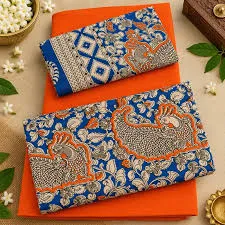
Kalamkari survives because of families and small workshops that keep a long and demanding process alive. Cheap prints sold under the same name make that harder. Choosing genuine pieces, even small ones like a dupatta or a wall hanging, directly supports artisans and helps keep one of India’s most distinctive textile traditions alive.